

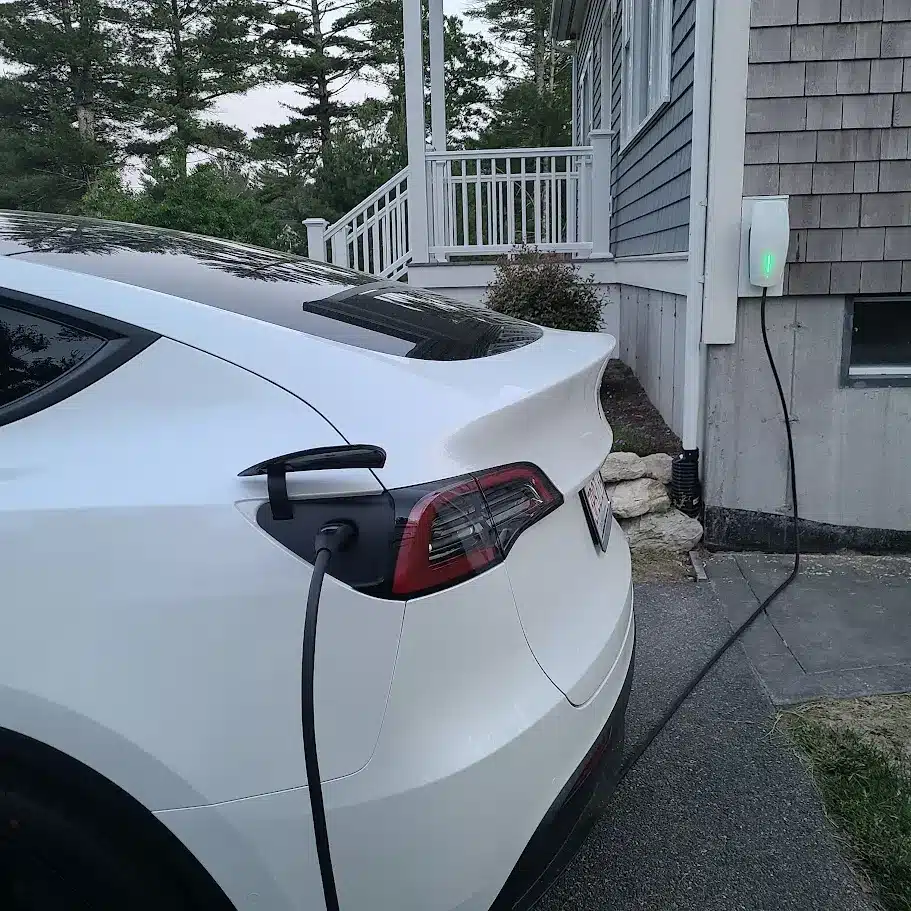
Part of your complete home energy system.
EV Charging for Your Home
Convenient charging starts with the right electrical plan. We match charging equipment, service capacity, and installation details to your vehicle, driveway or garage, and daily driving.
Built around your daily routine
Come home. Plug in. Be ready for tomorrow.
Your Daily Driving
Your mileage and time parked at home help determine a practical charging rate. More charger power is not always necessary for a full overnight recharge.
Your Garage or Driveway
Choose a convenient location with enough cable reach, suitable mounting, and a safe route from your electrical panel.
Your Home’s Energy Plan
Plan charging alongside solar, batteries, heat pumps, and other household loads. Explore Your Complete Home Energy System
Choose the right home charging setup
Home charging options, explained.
Level 1: Slower Charging
120 V charging may suit modest daily driving and long parking periods. It requires suitable listed equipment and an appropriate outlet and circuit verified for the load.
Level 2: Everyday Convenience
240 V charging is a common choice for charging at home while you sleep. A dedicated, correctly sized circuit and compatible equipment support your vehicle’s charging needs.
Controls That Fit Your Routine
Scheduling and supported load management can coordinate charging with your household demand, utility plan, or available solar production. We help you understand the controls included with your equipment.
Actual charging speed depends on the vehicle, charger, available electrical capacity, state of charge, and battery temperature. We size the installation around your driving and charging window.
Before choosing a charger
Plan the whole installation.
Electrical Capacity
Review the service, panel space, existing loads, and a load calculation. Compatible load management may be an option; a service upgrade is not automatically required or automatically avoidable.
Parking & Cable Route
Confirm the mounting location, cable reach, conduit path, trenching, exposure, and accessibility before installation.
Vehicle Compatibility
Confirm connector type, vehicle charging limits, and any manufacturer-approved adapter requirements. Plan for the vehicles you use today and expect next.
Smart Controls
Scheduling and supported load sharing can manage charging demand. Network reliability and the equipment’s behavior when connectivity is lost also matter.
A Second EV
If another electric vehicle is in your plans, consider compatible power sharing and the charging time each driver needs before adding equipment.
Future Expansion
Consider spare conduit, electrical capacity, and a route for another charger if your household needs change.
Beyond charging: V2H & V2L
Your EV can do more than charge.
Some electric vehicles can send stored energy back out of the battery. What you can power depends on the vehicle, supported equipment and how the system is configured.
V2H: Vehicle-to-Home
Use a compatible EV to supply backup energy to your home during an outage. V2H requires an approved home-backup system, including the equipment and controls needed to safely separate your home from the utility grid.
V2L: Vehicle-to-Load
Power individual devices—such as tools, camping equipment or small appliances—through supported vehicle outlets or manufacturer-approved adapters. V2L does not by itself provide backup through your home’s electrical panel.
A standard charging installation alone does not provide home backup. BD can evaluate your vehicle, electrical system and backup goals together, including the loads you want to run and the energy you need to preserve for driving.
Explore Tesla Powershare
Tesla Powershare offers supported vehicle-to-home and device-power capabilities. Eligibility and equipment requirements vary by vehicle and use. Our Powershare guide explains compatible configurations, Powerwall integration and how to plan for an outage.
What about charging from solar?
Solar-aware charging uses compatible controls to match charging with available solar production. It is a separate capability from V2H home backup or V2L device power.
Explore Powerwall 3 · Explore Tesla Wall Connector · Explore the Complete Residential Energy System · Explore Smart Panels & SPAN
A clear installation process
Assess. Install. Commission.
1. Assess
Review vehicles, parking, charging windows, service capacity, and the installation route.
2. Design & Install
Select equipment, coordinate required permits and utility work, and install the charging infrastructure.
3. Test & Handoff
Verify operation, show you how to use your charger, and explain the app settings and support included in your installation.
See our residential work
Home charging in Plymouth.
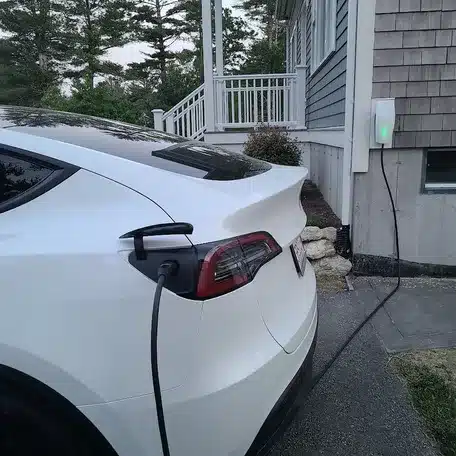
Convenient charging where you park.
This installation provides dedicated Level 2 charging at a Plymouth home, with an exterior-rated Wall Connector positioned for driveway access.
The charger location, cable route, electrical connection, and vehicle access were planned together.
EV charging questions
Get ready for your next vehicle.
Do I need a service upgrade?
Not always. We evaluate existing loads and service capacity, then compare a suitable charging rate, compatible load management, and any required electrical upgrade.
Can I charge from my solar panels?
Solar can offset charging energy. Matching charging to solar production requires compatible controls and enough available power; charging at night may use grid or stored energy.
Can one system support multiple chargers?
Yes, when designed for it. Power sharing, available capacity, parking layout, and network compatibility determine the right approach.
Can an EV power my home during an outage?
Only a specifically compatible bidirectional system can do that. Tesla Powershare can support eligible vehicles with the required equipment and configuration. Review Powershare compatibility. Ordinary Level 2 charging equipment alone does not provide home backup.
Let’s Plan Your EV Charging
Tell us about your vehicles, parking, and electrical service. We will help you choose a practical charging plan.