

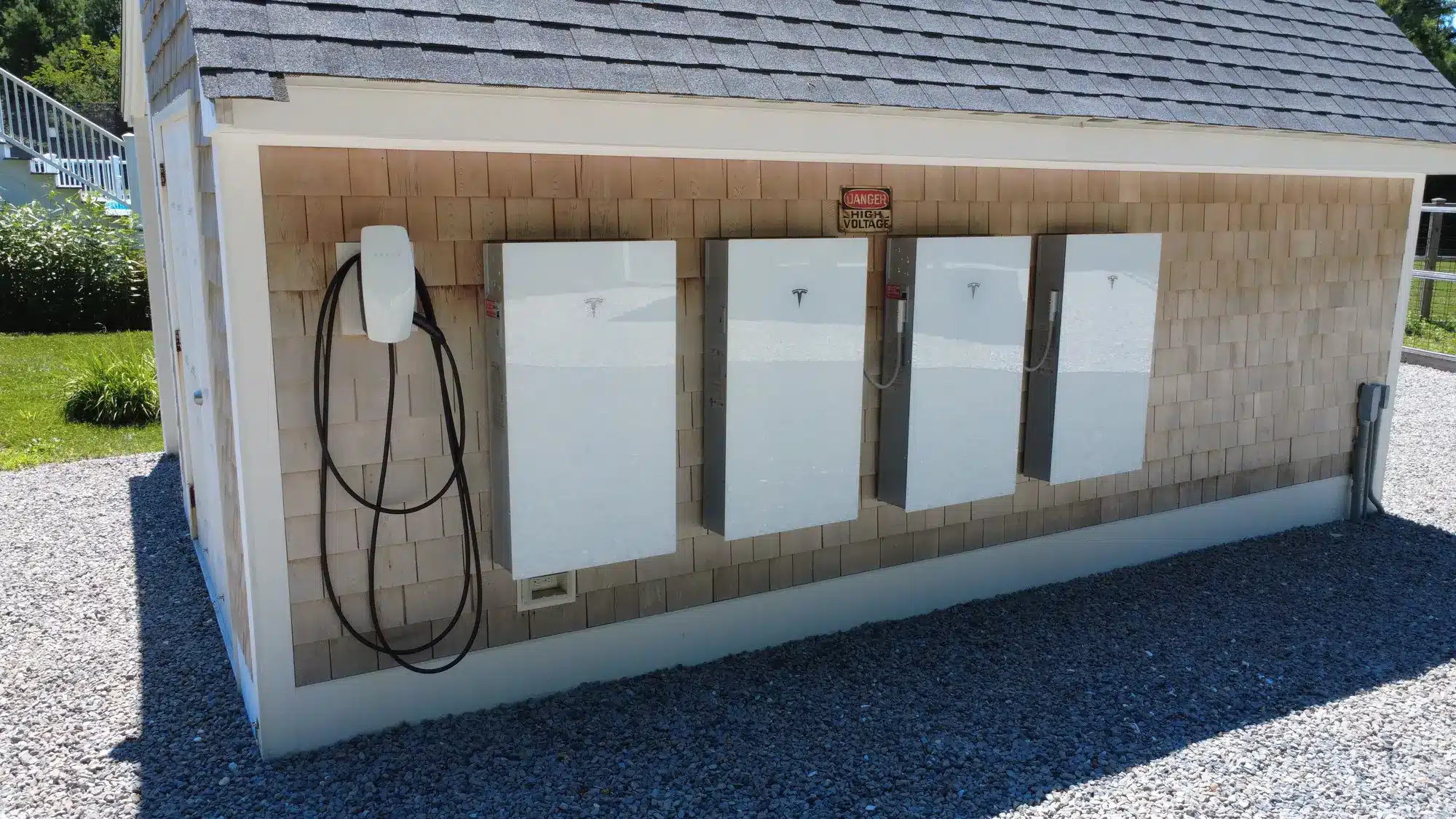
Part of your complete home energy system.
Home Battery Storage & Backup Power
Store energy for later, support important loads during an outage, and coordinate solar with the way your home uses electricity. Start with what you need to power—not just the size of the battery.
Define your backup priorities
What do you need to keep running?
Choose Your Loads
Refrigeration, lighting, internet, well pumps, heating equipment, and other priorities determine the backup design. Large starting loads need special attention.
Choose Your Duration
The number of hours you need, daily consumption, solar recharge potential, and reserve settings determine how much stored energy is useful.
Plan the Integration
New solar, an existing solar retrofit, or a battery without solar each requires a different equipment review. We assess panels, transfer controls, and expansion plans.
Power and energy are different
kW tells you how much. kWh tells you how long.
Power: Kilowatts (kW)
Output power determines which loads can run together. Starting a motor can require more power than keeping it running, so continuous output and startup capability both matter.
Energy: Kilowatt-hours (kWh)
Stored energy helps determine runtime. A hypothetical 10 kWh of available energy serving a steady 1 kW load would last 10 hours before losses and other limits. This is an illustration, not a runtime guarantee.
Your Actual Runtime
Temperature, usable capacity, backup reserve, changing loads, conversion losses, and available solar affect the result. We size around your priorities and explain the assumptions.
Connect the system correctly
AC-coupled or DC-coupled?
AC-Coupled Storage
The battery uses its own inverter and connects on the AC side of the electrical system. This can be a practical path for adding storage to existing solar.
DC-Coupled Solar & Storage
Solar and batteries connect through compatible equipment on the DC side. This can suit a new integrated solar-and-storage design.
Architecture Is Not a Backup Rating
Either approach can support substantial backup when properly sized. Whole-home coverage depends on loads, output, storage, and controls—not the coupling label. Powerwall 3 supports both AC- and DC-coupled solar configurations.
Compare the right equipment
Battery options we can evaluate.
Tesla Powerwall 3
13.5 kWh nominal energy and up to 11.5 kW nominal AC output, depending on configuration. Supports integrated or compatible existing solar. Generator operation requires a separate compatible arrangement; Powerwall does not charge from a generator. Tesla system compatibility
FranklinWH aPower 2
15 kWh capacity and 10 kW continuous output per battery. With the appropriate aGate configuration, supported generators can power loads and recharge batteries. aPower 2 details
Enphase IQ Battery 5P
5 kWh usable energy and 3.84 kW continuous power per unit at 240 V. A modular option; backup and generator integration require the appropriate system controller and compatible equipment. IQ Battery 5P details
These are specific model examples, not interchangeable packages. We confirm current availability, supported expansion limits, equipment generations, utility requirements, and commissioned settings before specifying your system.
Built around your household
Backup that fits the way you live.
Essential Home Loads
Start with the equipment you most want to protect: refrigeration, lighting, internet, well pumps, heating controls, and other household priorities.
More of Your Home
Broader coverage requires a review of simultaneous loads, motor starting power, battery capacity, and load management. We explain which appliances can operate together. Explore Smart Panels & SPAN
Longer Outages
Compatible solar, batteries, and a generator can work together to extend resilience. The equipment and operating sequence determine how your home is supplied and how batteries recharge. Explore Generators & Backup Power
See our residential work
Battery systems built around the home.


Battery questions
Know what your system will do.
Can I add storage without replacing my solar?
Often, yes. We review the existing inverter and electrical configuration before selecting compatible storage and backup controls.
Will one battery run my entire home?
That depends on simultaneous loads, startup power, available energy, and desired runtime. Some homes need load management, more storage, or selected-circuit backup.
Can I add more batteries later?
Expansion is product- and generation-specific. We confirm supported battery quantities, controller limits, space, and electrical provisions during design.
Can a generator recharge the batteries?
Some supported systems can, including appropriate FranklinWH and Enphase configurations. Powerwall does not charge from a generator. We specify the exact equipment and operating sequence for your project.
Let’s Design Your Backup Plan
Tell us which loads matter, what solar you already have, and how you want your home to operate during an outage.